Step Counter · Guide
How Many Steps Is 1 km? (and 1 Mile)
For an average adult it's about 1,400 steps per kilometre and 2,300 per mile — but your height and pace move that number. Here's a table by height, how your iPhone counts steps, and how to find your own.
On this page8 sections
Quick answer
About 1,400 steps per km (2,300 per mile) for a 170 cm (5′7″) adult walking at an easy pace. Taller people need fewer steps: about 1,300 per km at 185 cm, 1,500 at 160 cm. A common rule puts your stride at 41.5 % of your height.
- Stride ≈ height × 0.415 → 170 cm ≈ 71 cm per step.
- Steps per km = 100,000 ÷ stride in cm.
- 10,000 steps ≈ 7 km (4.4 miles) at 170 cm.
Steps per km and mile by height
Your step count for a kilometre depends on the length of one step — your stride. A rule of thumb used in pedometers is stride ≈ height × 0.415 (0.413 for women — the difference is under 1 %). Steps per km is then 1,000 m divided by that stride. These are the numbers it gives:
| Your height | Steps per km | Per mile · stride |
|---|---|---|
| 150 cm · 4′11″ | ≈ 1,610 | ≈ 2,590 per mile · 62 cm |
| 155 cm · 5′1″ | ≈ 1,550 | ≈ 2,500 per mile · 64 cm |
| 160 cm · 5′3″ | ≈ 1,510 | ≈ 2,420 per mile · 66 cm |
| 165 cm · 5′5″ | ≈ 1,460 | ≈ 2,350 per mile · 68 cm |
| 170 cm · 5′7″ | ≈ 1,420 | ≈ 2,280 per mile · 71 cm |
| 175 cm · 5′9″ | ≈ 1,380 | ≈ 2,220 per mile · 73 cm |
| 180 cm · 5′11″ | ≈ 1,340 | ≈ 2,150 per mile · 75 cm |
| 185 cm · 6′1″ | ≈ 1,300 | ≈ 2,100 per mile · 77 cm |
| 190 cm · 6′3″ | ≈ 1,270 | ≈ 2,040 per mile · 79 cm |
Want the number for your exact height, or for your step count? Use the free Steps to km, miles & calories converter — same formula, plus a calorie estimate.
Pace changes it too
The rule is tuned for an easy walk of about 1 m/s (3.6 km/h). When you walk briskly your stride gets longer, so you need fewer steps per km; strolling, pushing a buggy or walking uphill means shorter steps and more of them. Running stretches the stride much further, so a running kilometre takes far fewer steps than a walking one. At an everyday pace of about 5 km/h, a kilometre takes around 12 minutes.
How your iPhone counts steps
The iPhone has a motion sensor (accelerometer) and a low-power motion chip that count the rhythm of your steps all day, even when the screen is off. That’s what the Health app and step apps read. The distance is an estimate built from those steps and the length of your stride — so a correct height in Health and a phone that moves with you both matter.
It works best when the iPhone is in a trouser pocket or held while you walk. In a bag, on a pram or on a treadmill handrail it can miss steps; on a bumpy bus ride it can occasionally add some. An Apple Watch on your wrist records steps too. When several devices or apps record the same kind of data, Health gives priority to the source at the top of its list, which you can reorder under Data Sources & Access.
Method 1 — Free: measure your own stride
The rule of thumb is an average. Ten minutes on a known distance gives you your own number.
Step 1: Find a known distance
A standard running track is 400 m per lap in the inside lane. A football pitch or a marked path with distance posts also works.
Step 2: Walk it and count
Walk one lap at your normal pace and count your steps — or note the step count in the Health app before and after. Walk it twice and take the average.
Step 3: Do the maths
Steps per km = steps for 400 m × 2.5. Your stride in cm = 40,000 ÷ steps for 400 m. If 400 m took 560 steps, that's 1,400 steps per km and a stride of about 71 cm.
Step 4: Keep your height up to date
In the Health app tap Summary → your picture → Health Details → Edit and check your height. Step apps that estimate distance from your steps rely on a correct height — in Step Counter it's in Me → Profile.
Method 2 — Step Counter: steps and km automatically
Step Counter counts your steps all day without a start button — from Apple Health if you connect it, otherwise from the iPhone’s motion sensor — and shows the distance in km or miles.
Step 1: See steps and distance on Today
Today shows your steps against your daily goal and, under «Today so far», the distance, calories and active minutes. Here 7,812 steps are 5.5 km.
Fig. 1 — 7,812 steps · 5.5 km
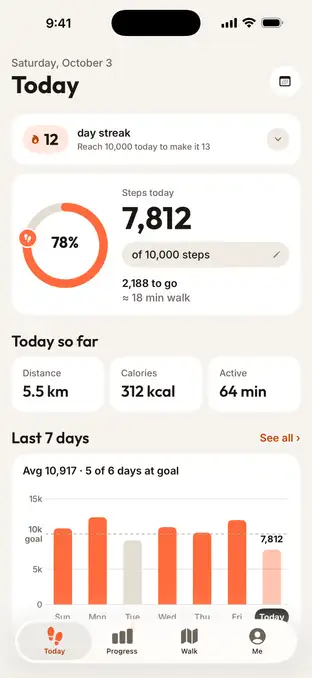
Fig. 1 — 7,812 steps · 5.5 km
Step 2: Pick km or miles
In Me → Units choose km or mi (and kg or lb). The choice applies everywhere, widgets included. Add your height and weight in Me → Profile too.
Step 3: Close the gap with a walk
Short of your goal? The Walk tab shows the steps left and roughly how many minutes they take. Start a GPS walk to see the time and distance as you go.
Fig. 2 — 2,188 steps ≈ 18 min
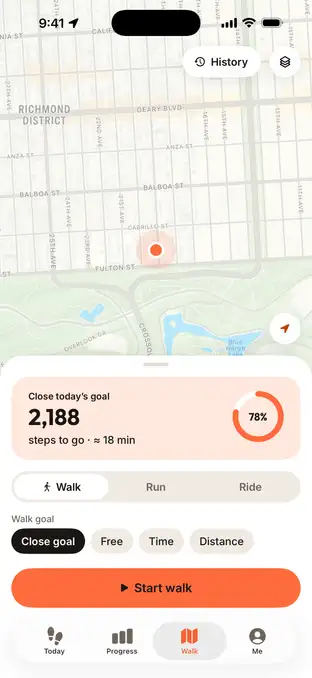
Fig. 2 — 2,188 steps ≈ 18 min
Step 4: Find your own steps per km
After a GPS walk, divide the steps added (shown in the summary) by the distance the walk recorded. That's your real number at that pace — no counting needed.
Fig. 3 — Goal reached
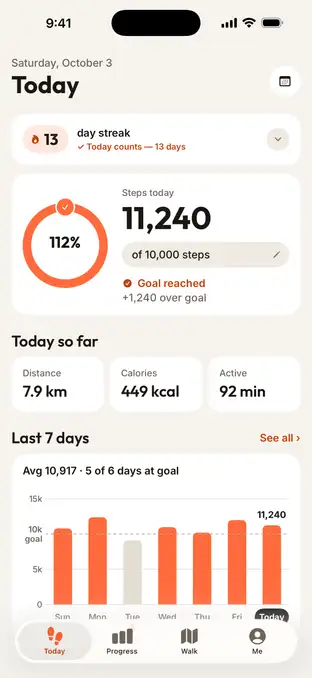
Fig. 3 — Goal reached
Typical numbers
These are typical values, not our own walk. The first three rows use the height rule above; the last two convert widely quoted averages into steps per kilometre.
| Basis | Steps for 1 km | Stride |
|---|---|---|
| Height rule · 160 cm | ≈ 1,510 | ≈ 66 cm |
| Height rule · 170 cm | ≈ 1,420 | ≈ 71 cm |
| Height rule · 185 cm | ≈ 1,300 | ≈ 77 cm |
| Average step of 2.5 ft | ≈ 1,310 | ≈ 76 cm |
| «2,000 steps per mile» | ≈ 1,240 | ≈ 80 cm — a tall or brisk walker |
Sources: the height rule (0.415 × height for men, 0.413 for women, tuned for walking at about 1 m/s) as described in US patent 10,473,689 «Pedometer in a low-power device»; the 2.5-ft average step (University of Iowa) and «about 2,000 steps to walk a mile» as quoted by Healthline. Measuring your own stride (Method 1) beats any average.
Troubleshooting
No steps at all?
Open Settings → Privacy & Security → Motion & Fitness: Fitness Tracking must be on, and the step app must be allowed in the list.
Distance looks too short or long?
Correct your height in the Health app, then compare with a GPS walk of a known route.
Steps appear later?
The motion chip stores steps and apps read them when opened. Open the app and they catch up — the steps are not lost.
Different number from the Health app?
Apps can read different sources: Health (with your Watch) or the iPhone sensor. Pick one source and stick with it.
FAQ
How many steps is 1 km walking?
About 1,300–1,500 for most adults at a normal pace. With the height × 0.415 rule, a 170 cm person takes about 1,420 steps per km. Walk faster and your stride gets longer, so the number goes down.
How many steps is a mile?
About 2,000–2,600. At 170 cm (5′7″) it's about 2,280 steps; at 185 cm (6′1″) about 2,100.
How far is 10,000 steps?
Roughly 6–8 km (4–5 miles), depending on your height — about 7.1 km (4.4 miles) at 170 cm.
How long does it take to walk 1 km?
About 10–15 minutes at an everyday pace; around 12 minutes at 5 km/h.